
Information Gain Summary: Modern Total Knee Arthroplasty (TKA) procurement has moved beyond traditional price-per-unit metrics. Healthcare systems now require implants engineered for physiological kinematics (such as Medial Pivot design), bio-inert hypoallergenic coatings (TiN/Sensitin) to combat heavy metal sensitivity, and streamlined single-use or patient-specific instrumentation (PSI) to optimize operating room turnover times. This document provides clinical, regulatory, and financial benchmarks to inform large-scale procurement strategies.
1. Biomechanical Evolution & Intent-Driven Procurement in TKA Implants
Total Knee Arthroplasty (TKA) remains one of the most successful surgical procedures in modern orthopedics. However, clinical intent analysis across healthcare buyers reveals a persistent gap: up to 20% of traditional TKA patients express dissatisfaction due to residual pain, mid-flexion instability, or unnatural joint feel ("the artificial knee sensation").
When global procurement teams evaluate total knee arthroplasty implants today, the strategic objective must shift from basic anatomical restoration to replicating natural knee kinematics. Traditional Posterior-Stabilized (PS) and Cruciate-Retaining (CR) designs often force symmetrical anterior-posterior gliding, resulting in non-physiological kinematic patterns, paradox slide, and elevated shear stresses on polyethylene inserts.
To overcome these challenges, advanced surgical centers are migrating toward Medial Pivot knee architectures. Medial pivot systems mirror the native knee's biomechanics—where the medial condyle acts as a stable ball-and-socket joint permitting natural rotation, while the lateral condyle translates freely throughout flexion.
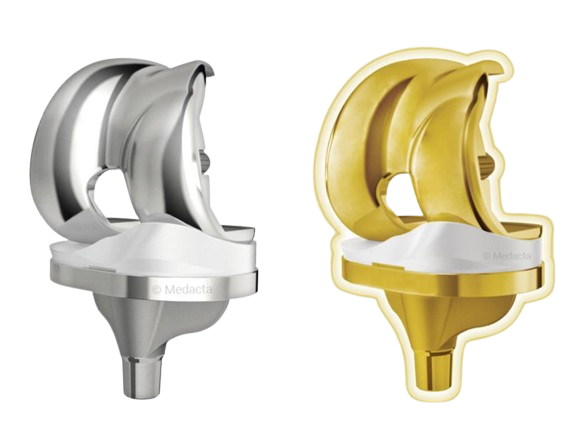
Featured System: GMK Sphere (Medacta International)
Distributed by Habakkuk Health, the GMK® Sphere represents the pinnacle of physiological total knee arthroplasty implants. Designed around the concept of true ball-and-socket medial stability, it restores physiological stability during daily movements such as stair climbing, squatting, and chair rising.
- Medial Stability: High-conformity spherical medial compartment prevents anterior-posterior subluxation.
- Lateral Freedom: Flat lateral plateau allows physiological posterior femoral rollback without unnatural constraint.
- Patellofemoral Synergy: Smooth, anatomical trochlear groove reduces patellar friction and anterior knee pain.
2. Technical Architecture & Biomaterials Specification Matrix
Selecting the optimal total knee arthroplasty implant requires rigorous engineering evaluation of the underlying substrate materials, surface processing technologies, and insert wear dynamics. B2B procurement managers must verify compliance with international standards (ISO 5832, ASTM F75, ASTM F136) to ensure long-term structural integrity and low wear rates.
| Implant Component | Standard Material Grade | Advanced Coating / Treatment | Clinical & Mechanical Objective |
|---|---|---|---|
| Femoral Component | CoCrMo Alloy (ASTM F75) / Cast Cobalt-Chrome | Sensitin (PVD Titanium Nitride - TiN) / PVD Ceramic | Hypoallergenic barrier; reduces Nickel/Chromium ion release by >95%; ultralow friction coefficient. |
| Tibial Baseplate | Ti-6Al-4V Titanium Alloy (ISO 5832-3) | Plasma-sprayed Porous Titanium + Hydroxyapatite (HA) | Optimal modulus of elasticity matching cortical bone; promotes rapid osseointegration in cementless TKA. |
| Articular Insert | UHMWPE (Ultra-High Molecular Weight Polyethylene) | Highly Cross-Linked (HXLPE) with Vitamin E Stabilization | Neutralizes free radicals; prevents oxidation degradation; ultra-low volumetric wear rate (<2 mm3/million cycles). |
| Patella Component | All-Polyethylene / Metal-Backed XLPE | Anatomic Resurfacing or Inset Design | Restores extensor mechanism tracking; mitigates wear-induced osteolysis. |
Hypoallergenic & Low-Friction Surface Engineering (Sensitin Technology)
Metal hypersensitivity (particularly to Nickel, Cobalt, and Chromium) is an increasingly documented cause of aseptic loosening, unexplained joint pain, and early implant failure in total knee replacement. Standard CoCrMo implants release micro-trace ions into surrounding tissue over time.
Through our primary partnership with Medacta, Habakkuk Health offers the Sensitin Gold Coating—a physical vapor deposition (PVD) layer of Titanium Nitride (TiN). This ceramic-like barrier exhibits an extremely smooth surface finish (Ra < 0.01 µm), significantly reducing polyethylene wear while shielding sensitive patients from metallic allergen exposure.
Global Manufacturing Partners Represented by Habakkuk Health



3. Sourcing & Procurement Trends Shaping the TKA Landscape (2025–2035)
Hospital purchasing directors, ASC (Ambulatory Surgical Center) network administrators, and healthcare ministry buyers face complex decisions driven by demographic aging, economic pressures, and rapid technological convergence. Key macro trends reshaping total knee arthroplasty implant procurement include:
Trend 1: Transition from Mechanical Alignment (MA) to Kinematic Alignment (KA)
Historically, orthopedic surgeons aimed for a neutral 90-degree mechanical axis in every patient, often requiring aggressive soft-tissue releases. Today, clinical literature heavily supports Kinematic Alignment (KA) and Functional Alignment (FA), which preserve the patient's constitutional joint line and soft-tissue envelope. Modern TKA implant systems must feature versatile instrumentation and implant geometry options (such as asymmetric condylar options and adaptable stem extensions) to support surgeon-led KA philosophies seamlessly.
Trend 2: Patient-Specific Instrumentation (PSI) & Digital Planning Ecosystems
Procurement departments are reducing hospital inventory burdens by adopting Patient-Specific Instrumentation. Using preoperative 3D MRI or CT modeling (such as Medacta's MyKnee® technology), customized 3D-printed cutting blocks are delivered pre-sterilized for each individual case. Benefits include:
- Reduced Instrument Trays: Reduces OR tray setup from 5-7 heavy trays down to 1-2 targeted trays.
- Sterilization Savings: Decreases hospital central sterile processing costs by up to 60% per case.
- Surgical Precision: Pre-validated resections improve resection accuracy and alignment outcome consistency.
Trend 3: Expansion of Cementless (Press-Fit) TKA Fixation
Driven by younger, more active patient demographics undergoing total knee replacement, demand for cementless TKA implants is surging. Titanium porous coatings paired with Hydroxyapatite (HA) facilitate biological bone ingrowth, eliminating PMMA bone cement degradation over decades of use. Sourcing managers must negotiate procurement contracts that provide both cemented and press-fit options within the same core system line.
Request Complete TKA System Specs & Supply Terms
Access technical dossiers, clinical trial wear data, regulatory certificates (FDA 510(k), CE Mark), and tier-based B2B pricing for hospital systems.
4. Why Habakkuk Health: Strategic Value & Corporate Advantage
Selecting an implant system extends far beyond technical specifications—it requires a dependable, clinically agile supply partner. Habakkuk Health operates as a specialized distributor and strategic consulting firm focused on delivering premium joint reconstruction, trauma, and fixation systems across healthcare networks.
Core Strengths of the Habakkuk Health Ecosystem:
- World-Class Manufacturing Synergies: We partner exclusively with premier global medical device manufacturers, such as Medacta USA, Newclip Technics, and MPM Medical. This provides our hospital client network direct access to clinically validated, Swiss-engineered implants and advanced surgical solutions.
- In-OR Clinical Consulting & Education: Every member of our sales and clinical support team is deeply trained in orthopedic biomechanics, surgical technique, and implant sizing. We act as standard-setting partners inside the operating room, guiding surgical teams through complex primary and revision cases.
- Supply Chain Reliability & Inventory Management: Rooted in our headquarters in Oklahoma City, OK, Habakkuk Health maintains robust local and regional inventory buffers. We guarantee rapid delivery of implants, custom PSI guides, and specialized surgical instrumentation, effectively eliminating surgical delays.
- Dedicated Mission & Restoration Group Heritage: As part of the Restoration Group family of companies, Habakkuk Health is grounded in relational integrity and human-centric service. We treat every implant delivery not as a transaction, but as a direct contribution to restoring a patient's quality of life.

5. Frequently Asked Questions (B2B Procurement & Clinical FAQ)
Q1: How does a Medial Pivot TKA implant compare to standard Posterior-Stabilized (PS) implants in long-term survivorship?
Medial Pivot implants (such as the GMK Sphere) have demonstrated outstanding long-term survivorship (exceeding 98.5% at 10 years in joint registry datasets). Because the high-conformity medial side prevents abnormal anterior femoral translation ("paradoxical sliding"), wear on the polyethylene insert is uniformly distributed, reducing shear force and osteolysis compared to traditional PS post-and-cam designs.
Q2: What regulatory clearances accompany your total knee arthroplasty implants for international procurement?
All total knee arthroplasty implant systems distributed by Habakkuk Health carry comprehensive regulatory certifications, including US FDA 510(k) clearances, European Union Medical Device Regulation (EU MDR 2017/745) certificates, ISO 13485 quality system certifications, and registration approvals across major Latin American, Asian, and Middle Eastern health authorities.
Q3: Can your total knee systems be ordered with patient-specific cutting guides to reduce sterilizer burden?
Yes. Through the MyKnee® Patient-Specific Instrumentation system, surgeons can create pre-operative 3D plans based on CT or MRI scans. Custom single-use anatomical cutting blocks are manufactured and delivered pre-sterilized for each patient. This eliminates up to 4 standard instrument trays per case, drastically reducing Central Sterile Supply Department (CSSD) workload and autoclave turnover times.
Q4: What surface coating options are available for patients with verified nickel or cobalt hypersensitivity?
For metal-sensitive patients, we offer the Sensitin® Titanium Nitride (TiN) coated femoral components. This PVD coating encapsulates the CoCrMo substrate in a ceramic-grade physical barrier, reducing metal ion release by more than 95% while offering superior scratch resistance and an exceptionally low friction coefficient.
Q5: What are the typical lead times, Minimum Order Quantities (MOQs), and consignment structures for hospital systems?
Habakkuk Health tailors supply contracts based on facility volume. We offer flexible arrangements including standing purchase agreements, local stocking consignment banks, and just-in-time delivery for scheduled cases. Standard stock replenishment for primary implant sizes is typically fulfilled within 24 to 48 hours.
Q6: How does Habakkuk Health support surgical training and hospital onboarding for new TKA implant lines?
We provide complete surgical team onboarding, including sawbone workshops, cadaveric lab facilitation, surgical technique documentation, scrub nurse tray organization guidance, and dedicated on-site clinical specialist representation during initial live surgical cases.
Elevate Your Hospital's Orthopedic Standards
Connect with our senior clinical sourcing specialists to review detailed sizing charts, biomechanical test data, and competitive wholesale catalogue terms.
Get Catalog