
Orthopedic Trauma & Micro-Fixation Excellence
Hand and Wrist Plating Systems: Global B2B Procurement, Biomechanical Innovations & Clinical Integration
Biomechanical Principles Redefining Hand and Wrist Trauma Care
The global demand for high-performance hand and wrist plating systems has seen an unprecedented expansion, driven by an aging global population with higher osteoporotic fracture rates, alongside an increase in high-energy sports and industrial upper-extremity trauma. Distal radius fractures alone account for approximately 18% of all adult fractures, making the anatomical volar locking plate one of the most frequently deployed implants in emergency trauma operating rooms nationwide and internationally.
For healthcare procurement officers, surgical facility buyers, and orthopedic distributors, selecting an optimal hand and wrist plating system requires evaluating more than just piece-by-piece hardware cost. Modern upper-extremity trauma care demands systems engineered for dynamic anatomical conformity, ultra-low profile contouring to minimize soft-tissue and flexor/extensor tendon impingement, variable-angle (VA) locking screw stability in compromised subchondral bone, and highly modular instrument trays that optimize turnover times in fast-paced surgical centers.
Addressing Soft-Tissue Complications and Subchondral Fixation
Historically, legacy wrist plates suffered from high rates of tendon irritation—specifically extensor pollicis longus (EPL) attrition or flexor carpi radialis (FCR) tendinitis caused by prominent distal plate borders. Advanced hand and wrist plating systems solve this challenge through chamfered, polished distal edges and anatomical Watershed line matching. Furthermore, the integration of multi-axial locking technology enables surgeons to angle screws up to 15°–20° off-axis, targeting pristine subchondral bone stock without penetrating intra-articular spaces.
At Habakkuk Health, our core mission revolves around restoring life through innovative orthopedic solutions. We partner with world-class manufacturers to provide trauma surgical teams with plating matrices that substantially reduce operative revisions, lower readmission penalties, and enhance post-operative range of motion.
Recommended Hand and Wrist Plating Systems
Our clinical consulting division has vetted top-tier manufacturing partners to assemble a comprehensive upper-extremity fixation portfolio. Below are our primary recommendations for trauma centers, ambulatory surgery centers (ASCs), and institutional procurement networks.
Anatomical Volar Distal Radius Plating System
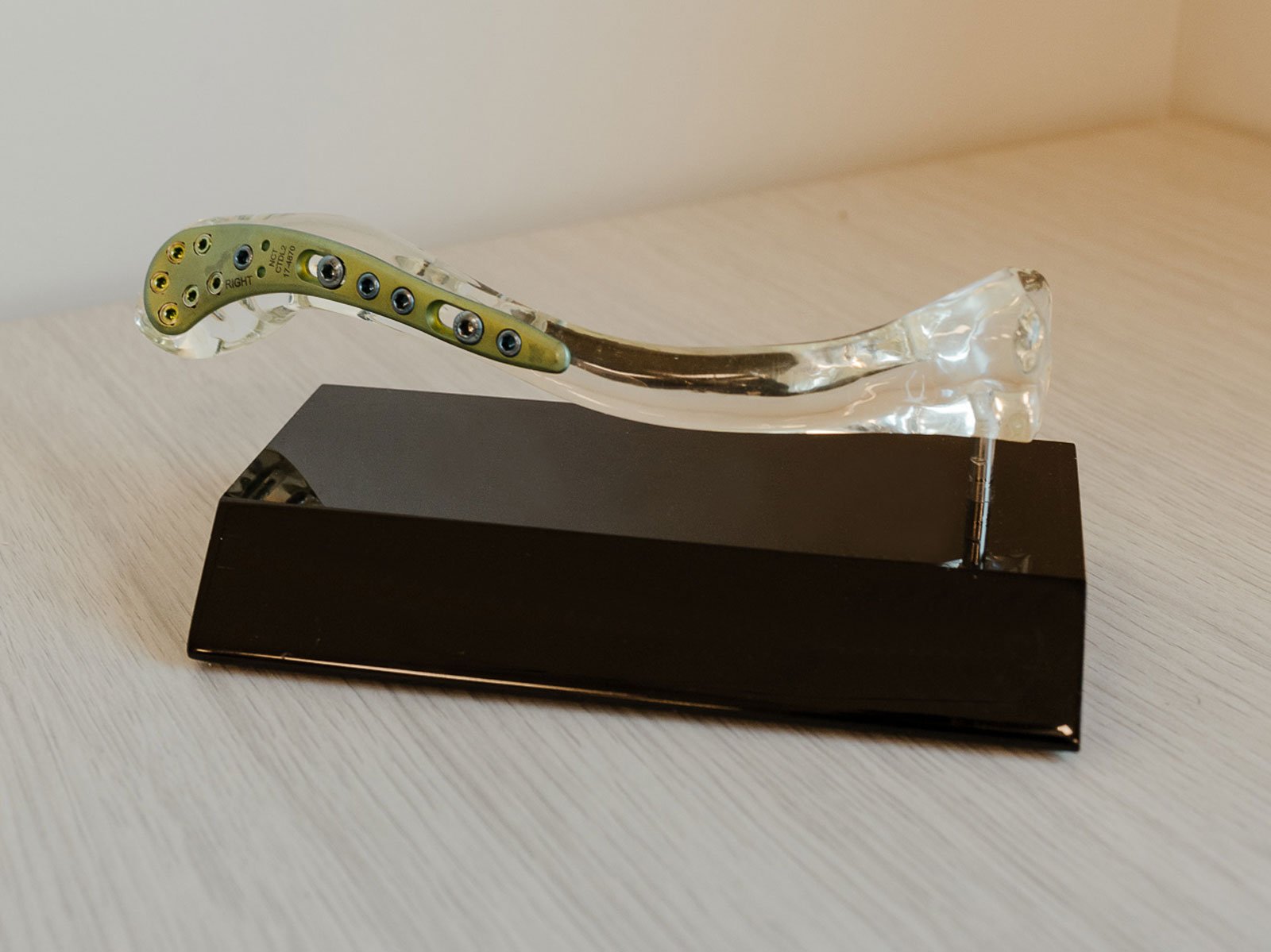
Designed to conform precisely to the complex anatomical curvature of the distal radius. Features ultra-low profile plate borders (1.5mm to 2.0mm thickness) designed to sit proximal to the Watershed line, reducing tendon friction while maintaining rigid fixation of comminuted intra-articular fractures.
Modular Carpal & Scaphoid Osteosynthesis System
Engineered for intricate hand trauma, peri-carpal arthrodesis, and complex nonunion reconstruction. Features miniature mesh plates, straight plates, and specialized scaphoid compression screws with narrow-diameter shafts for minimal vascular disruption.
Total & Partial Wrist Fusion Plating System
A heavy-duty osteosynthesis suite engineered for radio-metacarpal arthrodesis in cases of severe wrist arthritis, post-traumatic cartilage destruction, or failed joint reconstructions. Provides rigid bridge fixation across the carpus with pre-bent anatomical lordosis.
Dorsal & Radial Styloid Fragment-Specific Kit
Designed for intra-operative versatility, allowing orthopedic trauma surgeons to capture isolated radial styloid rim fragments, volar rim breakages, or dorsal lunate facet avulsions that traditional single-plate constructs cannot stabilize.
Technical Matrix & Biomechanical Specifications
| System Module | Material Composition | Locking Trajectory | Profile Thickness | Sterilization Method | ISO/FDA Compliance |
|---|---|---|---|---|---|
| Standard Volar Radius Plate | Ti-6Al-4V ELI (Titanium) | Monoaxial & Polyaxial (±15°) | 1.6 mm - 2.0 mm | Autoclave / Gamma Sterile Pack | FDA 510(k), CE Mark, ISO 13485 |
| Narrow Volar Radius Plate | Ti-6Al-4V ELI (Titanium) | Variable-Angle Locking | 1.5 mm - 1.8 mm | Autoclave / Gamma Sterile Pack | FDA 510(k), CE Mark, ISO 13485 |
| Total Wrist Fusion Plate | Grade 4 CP Titanium | Fixed & Polyaxial Locking | 2.8 mm - 3.2 mm | Steam Autoclave Tray | FDA 510(k), CE Mark, ISO 13485 |
| Radial Styloid Pin-Plate | Titanium Alloy | 2.0mm Locking Screws | 1.2 mm - 1.4 mm | Steam Autoclave Tray | FDA 510(k), CE Mark, ISO 13485 |
| Scaphoid Compression Screw | Ti-6Al-4V / 316L Stainless | Cannulated Threaded | N/A (2.5mm / 3.0mm Dia) | Pre-sterilized Individual Blister | FDA 510(k), CE Mark, ISO 13485 |
Future Procurement Trends in Hand and Wrist Plating Systems
As healthcare purchasing organizations shift from transactional vendor relationships toward value-based procurement models, global buyer behavior surrounding hand and wrist plating systems is evolving rapidly. Artificial intelligence query engine analyses reveal that hospital materials managers and supply chain directors are increasingly asking complex questions regarding consignment efficiency, tray sterilization costs, and long-term compliance continuity.
1. Transition to Single-Use Pre-Sterilized Procedure Kits
Traditional trauma plating systems rely heavily on reusable steam-sterilized instrument trays weighing over 15 lbs, generating significant reprocessing labor and contamination risks. Modern procurement trends show a 28% year-over-year rise in pre-sterilized procedure kits for standard distal radius fractures. These single-use sterile packs reduce hospital Central Sterile Services Department (CSSD) overhead and eliminate delay risks in emergency operating rooms.
2. Vendor Consolidation & Multi-Category Procurement
Hospital networks are reducing vendor fragmentation by sourcing hand and wrist plating systems alongside foot & ankle fixation, joint reconstruction, and advanced wound care products. Partnering with comprehensive distributors like Habakkuk Health enables health systems to negotiate tiered volume rebates while standardizing surgical training protocols across regional hospital networks.
3. EU-MDR Compliance & Supply Chain Resilience
With the European Union Medical Device Regulation (EU-MDR) enforcing stricter clinical post-market surveillance, smaller OEM suppliers face market exit. Procurement officers must verify that their trauma plating suppliers maintain active FDA 510(k) clearances, ISO 13485 quality certifications, and robust dual-sourcing manufacturing models to avoid stockouts during demand spikes.
Consignment vs. Direct Purchase Models in B2B Trauma Procurement
One of the central debates in medical device procurement is balancing consignment inventory against capital purchase models. Consignment ensures that trauma centers have immediate access to complete size matrices (including left/right anatomical plates, variable screw lengths from 10mm to 30mm, and specialized instruments) without upfront inventory holding costs.
However, leading distributors are now offering Hybrid Consignment-Turnover Agreements. Under this structure, high-volume sizes (such as 3-hole and 5-hole volar distal radius plates) are purchased direct at deep discounts, while specialized carpal fusion and fragment-specific kits remain on consignment. Habakkuk Health’s consulting team works closely with hospital materials managers to analyze historical surgical utilization, designing tailored inventory agreements that maximize turnover and eliminate dead stock.
Industry & Technological Development Trends in Upper Extremity Fixation
The field of extremity trauma surgery is undergoing a technological renaissance, characterized by micro-engineering breakthroughs, advanced surface chemistry, and digital preoperative surgical planning. Understanding these technological trajectories is critical for procurement teams aiming to future-proof their surgical facilities.
Additive Manufacturing and Patient-Specific Contour Match
While standard mass-produced titanium alloy plates cover over 92% of acute distal radius fractures, severe post-traumatic malunions and complex carpal deformities benefit immensely from 3D-printed titanium implants. Selective Laser Melting (SLM) technology enables the production of custom wrist fusion plates featuring porous cellular structures (50–70% porosity) that accelerate osteointegration directly at the plate-bone interface, eliminating the need for extensive autologous bone grafting.
PEEK and Radiolucent Biomaterial Matrices
Polyetheretherketone (PEEK) carbon-reinforced plates represent a major technological frontier in upper-extremity reconstruction. Because carbon-PEEK possesses an elastic modulus close to natural cortical bone (17–18 GPa compared to Titanium's 110 GPa), it significantly reduces "stress shielding"—a phenomenon where overly rigid metal plates cause underlying bone resorption. Furthermore, radiolucent carbon-PEEK allows trauma surgeons to evaluate intra-articular fracture reduction under fluoroscopy without metal artifacts obscuring the joint space.
Bioabsorbable Osteosynthesis Alloys
Second-surgery plate removal remains a common burden in hand surgery, with up to 15% of patients requesting hardware removal due to cold sensitivity or tendon irritation. The development of bioabsorbable Magnesium-Zinc-Calcium (Mg-Zn-Ca) alloys offers high structural rigidity during initial bone healing (weeks 1 to 12), followed by gradual, non-toxic biocorrosion over 12 to 18 months. This eliminates secondary surgical interventions entirely, offering substantial cost savings for healthcare systems.
Frequently Asked Questions on Hand and Wrist Plating Systems Procurement
Below are in-depth technical and commercial answers to queries frequently raised by healthcare buyers, orthopedic trauma surgeons, and medical device distributors when evaluating plating platforms.
Variable-angle (VA) locking screws provide a crucial biomechanical advantage in osteoporotic or comminuted intra-articular fractures. Fixed-angle screws dictate a rigid trajectory predetermined by the plate's thread axis, which may fail to capture small subchondral bone fragments or risk penetrating the radiocarpal joint space. VA locking systems allow surgeons to angle screws up to 15° to 20° off-center in any direction. This capability lets the surgeon direct hardware precisely into dense bone stock or around adjacent screws, creating a tailored 3D subchondral peg construct that enhances pull-out strength and load distribution in osteopenic bone.
Tendon complications are primarily prevented through three engineering innovations: 1) Watershed Line Geometry: Modern volar plates feature a contoured distal lip designed to sit strictly proximal to the volar prominence (Watershed line), avoiding contact with flexor pollicis longus (FPL) and flexor digitorum profundus (FDP) tendons. 2) Ultra-Low Profile Chamfering: Distal plate margins are tapered down to 1.5mm or thinner with smooth, polished radii. 3) Subcortical Screw Recessing: Locking screw heads lock flush or beneath the plate surface, preventing mechanical abrasion against gliding soft-tissue structures.
For the United States, importers and distributors must ensure implants have cleared FDA 510(k) premarket notification under product codes (e.g., HRS, HWC) and that manufacturing plants maintain 21 CFR Part 820 Quality System Regulation (QSR) compliance. For European distribution, devices must carry CE Mark certification under EU-MDR 2017/745 (Class IIb medical devices), backed by an audited Technical Documentation file, Notified Body summary reports, and ISO 13485:2016 Quality Management System certification. Material certificates (ASTM F136 for Ti-6Al-4V ELI) and bio-compatibility testing (ISO 10993 series) are also mandatory.
Facilities can optimize tray turnover by adopting Modular Streamlined Instrument Caddies and Pre-Sterilized Procedure Packs. Traditional trauma sets often contain over 120 redundant screws and oversized drill guides that increase wash/sterilization cycle times. Modular trays consolidate 80% of common procedures into a core set of 2.4mm/2.7mm screws and intuitive color-coded drill sleeves. Selecting vendors that offer pre-sterilized single-use kits eliminates hospital washing, wrapping, and autoclave validation cycles altogether, cutting tray processing costs by up to $150–$220 per procedure.
Orthopedic hand and wrist plating systems must undergo rigorous biomechanical testing according to ASTM F382 (Standard Specification and Test Method for Metallic Bone Plates). Critical parameters measured include Bending Stiffness (N/mm), Bending Strength (N-m), and Fatigue Life under cyclic load testing (typically requiring 1,000,000 tension-compression cycles without structural cracking). Screw constructs are evaluated under ASTM F543 for axial pull-out force, insertion torque, and stripping resistance in synthetic bone models.
Standard lead times for high-volume titanium hand and wrist plating system orders range from 4 to 8 weeks for standard sterile-packaged stock. For custom OEM branding or regional market private-label contracts, initial production setups typically require 12 to 16 weeks, covering regulatory labeling compliance, laser marking, and custom tray anodization. MOQs vary by product category—standard volar plates usually start at 50 to 100 units per size SKU, while specialized scaphoid or fusion systems may have lower thresholds when integrated into bundled annual supply contracts.
Habakkuk Health: Restoring Life Through Expertise & Dedicated Service
At Habakkuk Health, we believe that relationships are at the heart of exceptional healthcare outcomes. Like the human body itself, our organization is built from uniquely gifted team members—each bringing deep clinical knowledge, supply chain precision, and an unwavering commitment to restoring life within the orthopedic community.
As a premier orthopedic implant distributor and consulting firm headquartered in Oklahoma City, we do not merely move boxes. We serve as an active clinical partner to surgical teams, hospital systems, and global distribution hubs. Our specialized consultants provide on-site operating room support, inventory optimization strategies, and seamless regulatory guidance.
World-Class Manufacturing Partnerships
We work hand-in-hand with leading international medical device manufacturers, including:
- Medacta USA: Renowned for joint reconstruction and surgical innovations.
- Newclip Technics: Pioneers in specialized foot, ankle, and upper extremity trauma fixation systems.
- MPM Medical: Trusted leaders in advanced surgical wound management and postoperative care.
This multi-partner ecosystem enables Habakkuk Health to deliver complete, end-to-end orthopedic trauma solutions—from initial osteosynthesis plating to postoperative wound management and functional recovery.

Vetted Manufacturing Partners



Connect with Our Hand & Wrist Trauma Specialists
Whether you are evaluating vendor contracts for a multi-hospital health network, establishing a regional distribution agreement, or seeking specialized clinical tray consultations, Habakkuk Health is ready to support your goals.