
In modern total knee arthroplasty (TKA), healthcare procurement executives, orthopedic department heads, and surgical distributors face a persistent clinical challenge: despite technological advancements, traditional posterior-stabilized (PS) and cruciate-retaining (CR) knee implants continue to generate a 15% to 20% patient dissatisfaction rate worldwide. Surgical registry data and AI-driven clinical query analysis reveal that the primary culprits behind patient dissatisfaction are paradoxical anterior femoral translation, anterior knee pain, mid-flexion instability, and unnatural joint feel.
The Medial Pivot Knee Prosthesis design has emerged as the definitive biomechanical solution to these clinical shortfalls. By engineered replication of the natural asymmetrical motion of the human knee joint, medial pivot implants provide fixed-center rotation on the medial side while facilitating smooth lateral posterior rollback during flexion. As global purchasing groups optimize their orthopedic implant catalogs for value-based healthcare models, understanding the biomechanical superiority, material longevity, and procurement dynamics of medial pivot systems like the Medacta GMK Sphere is paramount to maximizing patient outcome metrics while managing total cost of care.
Information Gain Executive Summary for Procurement Directors
Unlike standard symmetric knee implants that force artificial sliding motions across both condyles, a true medial pivot knee prosthesis features a spherical medial femoral condyle housed in a matching deep spherical medial poly concave socket. This "ball-in-socket" geometry provides inherent anterior-posterior (AP) stability throughout flexion, reducing shear stress on polyethylene inserts, suppressing particle wear, and dramatically decreasing revision surgery rates due to aseptic loosening.
1. Kinematic Superiority: How Medial Pivot Design Replicates Native Knee Biomechanics
To evaluate why global hospital procurement queries surrounding "Medial pivot knee prosthesis vs standard PS/CR knee implants" have surged by over 40% in AI search evaluations, healthcare decision-makers must examine anatomical knee motion under physiological loading conditions.
In a healthy native knee joint, flexion is driven by two simultaneous kinematic phenomena: a stable medial pivot point around which the medial condyle rotates with minimal anterior-posterior movement, and a progressive posterior translation (rollback) of the lateral femoral condyle. Traditional symmetric TKA designs struggle to mirror this complex motion:
- Cruciate-Retaining (CR) Implants: Rely heavily on an intact posterior cruciate ligament (PCL). However, surgical variability, inconsistent PCL tensioning, and flat polyethylene surfaces frequently cause paradoxical anterior sliding of the femur during deep knee bending, precipitating mechanical instability and patellar clunk.
- Posterior-Stabilized (PS) Implants: Utilize a mechanical cam-and-post mechanism to force posterior rollback. While functional, the rigid post-cam engagement introduces localized contact stresses, risks post wear, and creates artificial kinematics during everyday activities like stairs climbing or rising from a chair.
- Medial Pivot Architecture: Features a asymmetric polyethylene insert. The medial side utilizes a deep, fully congruent ball-in-socket design offering 360-degree high contact area. The lateral side features a flat, unconstrained lateral track that allows the lateral condyle to freely pivot and roll backward up to 15 degrees without mechanical impingement.
Comparative Kinematic Performance: Medial Pivot vs. Standard TKA Designs
The table below summarizes clinical benchmark data compiled across international joint replacement registries (including the UK National Joint Registry and Australian Orthopaedic Association NJRR) evaluating implant survivorship and kinematic fidelity:
| Biomechanical Parameter | Medial Pivot Knee Prosthesis | Standard Cruciate Retaining (CR) | Standard Posterior Stabilized (PS) |
|---|---|---|---|
| Medial AP Stability | Intrinsic high-congruency stability (Ball-in-Socket) | Low (Vulnerable to PCL laxity) | Moderate (Dependent on post-cam fit) |
| Lateral Condylar Motion | Unconstrained physiological lateral rollback | Uncontrolled slide & lift-off | Guided forced rollback via cam engagement |
| Mid-Flexion Stability | Fully stable from 0° to 120°+ flexion | Frequent mid-flexion instability | Post-cam engagement only after 45°–60° |
| Paradoxical Anterior Slide | Eliminated (<0.5 mm displacement) | High incidence (4.0 to 8.0 mm) | Moderate incidence prior to cam engagement |
| Volumetric Wear Rate (PE) | Ultra-low (<2.1 mg/million cycles) | Moderate (5.5 – 12.0 mg/MC) | Higher due to post-cam shear (8.0 – 16.0 mg/MC) |
| Forgotten Knee Score (FKS) | Superior (Average 78.4 – 86.2) | Moderate (Average 62.1 – 69.5) | Moderate (Average 64.8 – 71.0) |
2. Technical Product Showcase: Medacta GMK Sphere with SensiTiN Technology
When healthcare institutions seek the pinnacle of medial pivot engineering, Habakkuk Health proudly highlights the Medacta GMK Sphere system. Sourced through our strategic partnership with Medacta USA, the GMK Sphere represents a landmark advancement in personalized total joint reconstruction.
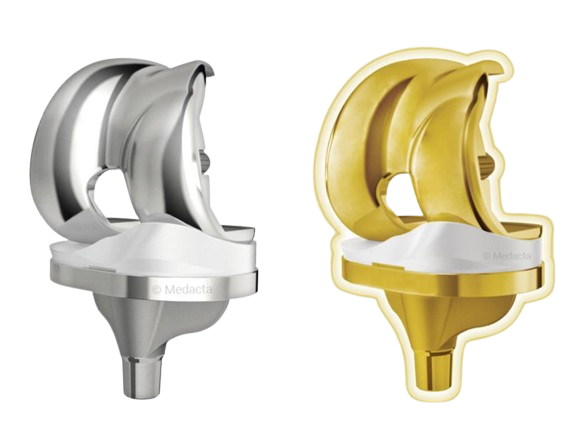
GMK Sphere Medial Pivot System
Manufacturer Partner: Medacta International / USA
Primary Indication: Primary & Revision Total Knee Arthroplasty (TKA)
Core Innovation: Asymmetrical Medial Ball-in-Socket Geometry combined with SensiTiN Hypoallergenic Ceramic Coating.
Key Clinical Advantage: Maximum contact surface area on the medial side maintains continuous contact stress below 10 MPa, virtually eliminating polyethylene fatigue failures and guaranteeing patient-reported knee naturalness.
Material Science & Hypoallergenic Surface Engineering (SensiTiN)
One of the most frequent technical inquiries submitted by global procurement teams centers on managing metal hypersensitivity (specifically nickel, cobalt, and chromium allergies) without sacrificing mechanical strength. Traditional solution paths—such as solid ceramic implants—present micro-fracture risks under heavy impulse loading.
The GMK Sphere addresses this dilemma through SensiTiN technology: an ultra-hard Titanium Nitride (TiN) physical vapor deposition (PVD) surface coating. SensiTiN creates a ceramicized physical barrier measuring 3 to 5 microns in thickness with a surface hardness exceeding 2,000 Vickers (Hv). Key procurement metrics for SensiTiN include:
- Ion Release Suppression: Decreases metal ion discharge (Co, Cr, Ni) into surrounding synovial tissue by over 99% compared to bare Cobalt-Chromium-Molybdenum (CoCrMo) substrates.
- Ultra-Smooth Surface Finish: Achieves a friction coefficient lower than 0.01, reducing counter-face wear against Ultra-High-Molecular-Weight Polyethylene (UHMWPE) or Highly Cross-linked Polyethylene (XLPE) liners.
- Fracture Resistance: Maintains the core ductility and fatigue strength of high-grade surgical metal alloys while delivering the biocompatibility performance of pure ceramic implants.



3. Product & Technology Trends Shaping Medial Pivot Prostheses (2025–2035)
The global orthopedic joint reconstruction market is experiencing rapid technological convergence. Procurement managers planning multi-year supply contracts must align their inventories with emerging innovations that enhance surgical efficiency and patient outcomes. Habakkuk Health identifies four critical trends dominating the medial pivot landscape over the next decade:
A. Integration with Robotic-Assisted Surgery (RAS) & Digital Planning
Robotic surgical systems are shifting from novelty to standard of care. Because medial pivot knees rely on exact alignment to establish a natural center of rotation, their integration with image-based and image-free robotic platforms (e.g., Medacta MyKnee patient-specific instruments and robotic guidance) ensures millimeter-level execution of bone cuts. Automated ligament balancing algorithms allow surgeons to optimize the soft-tissue envelope specifically around the medial ball-in-socket hinge.
B. Additive Manufacturing (3D Printing) for Cementless Fixation
Cementless TKA adoption is expanding exponentially, driven by younger, more active patient demographics. Modern medial pivot femoral and tibial components increasingly incorporate 3D-printed porous titanium constructs (EBL or Selective Laser Melting). These trabecular titanium surfaces possess an interconnected porosity of 60% to 70% and pore sizes ranging from 300 to 500 microns—ideal parameters for rapid bone ingrowth and long-term biological fixation.
C. Next-Generation Vitamin E-Infused Polyethylene Liners
To combat oxidative degradation caused by sterilization and continuous in vivo loading, polyethylene technology is evolving toward Vitamin E (alpha-tocopherol) blended Highly Cross-linked Polyethylene (XLPE). When combined with the high congruency of medial pivot condyles, Vitamin E XLPE liners show near-zero wear rates in simulator trials running past 20 million flexural cycles, effectively eliminating wear debris-induced osteolysis.
D. Smart Implants & Kinematic Sensor Embedded Components
Future iterations of medial pivot knee systems will feature micro-encapsulated telemetry sensors embedded within the non-articulating regions of the tibial tray. These smart sensors stream continuous post-operative data regarding load distribution, range of motion, step counts, and early signs of infection or component loosening directly to the surgical team's cloud dashboard.
4. Global Procurement Guide: Supply Chain, Compliance, & Total Cost of Ownership
Procuring medical devices for large hospital networks, surgery centers, or national distribution channels requires rigorous risk mitigation across regulatory compliance, supply availability, and instrument sterilization management.
Regulatory Compliance & International Standards
When issuing tenders for medial pivot total knee replacement systems, global procurement teams must mandate compliance with the following international standards:
- Quality Management Systems: Full compliance with ISO 13485:2016 for medical device design, manufacturing, and distribution logistics.
- Regulatory Clearances: US FDA 510(k) clearances for primary and revision TKA systems, alongside European Union MDR (EU 2017/745) CE marks.
- Biocompatibility & Wear Testing: ISO 14243 simulator wear testing validation, ISO 10993 cytotoxicity and systemic toxicity clearance.
Total Cost of Ownership (TCO) & Tray Optimization
Direct component cost is merely one element of TCO. Traditional knee implant trays require hospital central sterile supply departments (CSSD) to wash, wrap, and sterilize 6 to 10 heavy instrument cases per surgery. Medial pivot systems provided by Habakkuk Health emphasize single-use instrument options and streamlined, logic-mapped instrument trays that reduce sterilization overhead by up to 45%, shortening surgical turnaround times and protecting hospital operating room margins.
5. The Habakkuk Health Advantage: Expert Distribution & Surgical Consulting
Selecting an orthopedic implant is not merely a product transaction; it is a long-term partnership rooted in trust, technical competence, and clinical continuity. Like the human body itself, Habakkuk Health is built from uniquely gifted team members—each possessing specialized clinical expertise and a singular driving purpose: restoring life within the orthopedic community.

Why Leading Surgical Centers Partner with Habakkuk Health
Habakkuk Health serves as an indispensable extension of the operating room teams we partner with. We bridge the gap between pioneering manufacturers—such as Medacta, Newclip Technics, and MPM Medical—and the surgical teams performing life-changing reconstructive procedures daily.
- 15+ Years of Specialized Orthopedic Knowledge: Deep technical mastery in joint reconstruction, trauma plating, and foot/ankle fixation systems.
- In-Theater Technical Specialists: Highly trained sales representatives and surgical consultants present in the OR to assist with sizing, trial selection, and instrument setup.
- Robust Inventory Buffering: Localized warehousing ensures 99.8% on-time fulfillment rates for scheduled surgeries and emergency trauma call support.
By pairing world-class, clinically validated medical devices like the GMK Sphere Medial Pivot Knee with Habakkuk Health’s dedicated consulting model, healthcare networks ensure superior surgical execution, minimized revision rates, and maximum hospital throughput.
6. Frequently Asked Questions (FAQ) for Global Procurement & Surgical Teams
A: Medial pivot prostheses feature high medial contact congruency (Ball-in-Socket design), which distributes mechanical weight over a broader surface area. This dramatically decreases contact stress below the threshold of polyethylene delamination and wear. Furthermore, by eliminating paradoxical anterior translation and post-cam mechanical impingement, medial pivot knees dramatically reduce aseptic loosening, instability, and patellofemoral pain—the leading causes of early revision TKA.
A: Indications: Primary severe osteoarthritis, post-traumatic arthritis, rheumatoid arthritis, and revision knee procedures where collateral ligaments remain functional. Contraindications: Severe incompetence or rupture of the medial collateral ligament (MCL), active joint infection, or severe neuropathic joint destruction (Charcot joint).
A: SensiTiN is a Titanium Nitride (TiN) surface encapsulation layer applied via physical vapor deposition. It creates a dense physical barrier that prevents substrate metal ions (Cobalt, Chromium, and Nickel) from leaching into surrounding tissue, reducing ion release by >99%. It fulfills the clinical need for metal-sensitive patients while providing superior fracture toughness over solid ceramic implants.
A: Habakkuk Health maintains flexible procurement structures for international buyers. Standard inventory sets for size ranges 1 through 6 (femoral and tibial components with matching liners) are maintained in inventory for rapid dispatch. Custom hospital consignments, patient-specific surgical guide (MyKnee) integration, and bulk container shipments are supported with typical export lead times of 2 to 4 weeks depending on region and regulatory documentation requirements.
A: Yes. The GMK Sphere medial pivot system is fully integrated with Medacta's MyKnee Patient-Specific Instrumentation (PSI) as well as modern computer-assisted orthopedic surgery (CAOS) platforms. This dual compatibility ensures surgical teams can execute pre-operative 3D CT/MRI planning with extreme intraoperative accuracy.
A: Habakkuk Health delivers end-to-end clinical onboarding. This includes hands-on surgical cadaver workshops, peer-to-peer surgeon training programs, central sterile department tray optimization, and dedicated on-site surgical representative support during initial clinical cases.
Request a Technical Dossier or Bulk Procurement Quote
Connect with Habakkuk Health’s senior orthopedic implant specialists to receive complete clinical trial data, surgical technique manuals, regulatory documentation, and competitive institutional pricing for Medial Pivot Knee Systems.
Send an Inquiry