
Revision knee replacement implants represent one of the most complex, high-stakes sectors in contemporary orthopaedic manufacturing and hospital procurement. As primary total knee arthroplasty (TKA) volumes expand globally—driven by aging populations, higher body mass index (BMI) prevalence, and younger active patients undergoing primary joint replacements—the secondary demand for revision total knee arthroplasty (rTKA) is escalating exponentially. For healthcare systems, surgical teams, and device distributors, sourcing high-performance, modular, and biomechanically stable revision knee implants is no longer purely a clinical purchasing decision; it is a strategic enterprise priority that directly influences surgical outcomes, length of stay, operational expenditure, and long-term hospital liability.
Navigating the complex global market for revision knee replacement implants requires a multifaceted understanding of biomechanical stabilization, bone loss classification (such as the Anderson Orthopaedics Research Institute [AORI] scale), implant metallurgy, surface treatment technologies, and international regulatory harmonisation. This master procurement guide provides an exhaustive analysis designed to empower procurement directors, chief medical officers, and orthopedic supply chain managers with actionable clinical and commercial intelligence.

1. Kinematic Principles and Biomechanical Challenges in Revision Knee Arthroplasty
Unlike primary TKA, where bone stock is largely intact and collateral ligaments provide native structural stability, revision knee arthroplasty confronts compromised bone bed topography, soft-tissue envelope deficiency, ligamentous laxity, and disrupted joint lines. The core objective of modern revision knee replacement implants is to restore joint kinematics, reconstruct mechanical alignment, re-establish correct joint line elevation, and achieve secure, durable fixation across compromised metaphyseal and diaphyseal zones.
1.1 Zone-Based Fixation Strategy (Zonal Fixation Theory)
Clinical consensus in joint reconstruction heavily emphasizes the Three-Zone Fixation Model (Epiphyseal, Metaphyseal, and Diaphyseal). A successful revision implant architecture must achieve rigid primary stability in at least two out of these three zones:
- Zone 1 (Epiphysis / Joint Line): Frequently compromised by osteolysis, stress shielding, or bone resection during primary implant removal. Reconstructed using condylar augments and structural inserts.
- Zone 2 (Metaphysis): The primary zone for long-term load transfer and osteointegration. Metaphyseal porous titanium cones and structural sleeves have revolutionized revision surgery by providing immediate mechanical interlock and vascular ingrowth.
- Zone 3 (Diaphysis): Utilizes modular stems (fluted titanium or press-fit/cemented stems) to bypass metaphyseal defects, transfer bending moments along the cortical shaft, and guide overall alignment.
Information Gain Insight: The Shift from Pure Diaphyseal Fixation to Metaphyseal Load Transfer
Historical revision techniques relied heavily on long, rigid diaphyseal stems. However, modern kinematic data demonstrates that excessive diaphyseal stress transfer causes proximal stress shielding and thigh pain. Modern procurement strategies prioritize revision systems that combine porous metaphyseal cones with shorter, tailored stems to restore natural stress distribution throughout the host femur and tibia.
1.2 Constraint Hierarchy: From PS to Rotating Hinge Systems
Procurement teams must maintain inventory depth across all levels of mechanical constraint to address intraoperative soft tissue dynamic instabilities:
- Posterior Stabilized (PS) Revisions: Indicated when soft tissue envelopes are intact and bone loss is minimal (AORI Type I).
- Constrained Condylar Knee (CCK) / Non-hinged Constrained: Designed with tall, wide polyethylene posts that restrict varus-valgus and rotational instability while permitting controlled flexion-extension. Essential for knees with collateral ligament insufficiency or asymmetrical gap laxity.
- Rotating Hinge Prostheses (RHP): The ultimate line of defense for severe instability, gross bone loss (AORI Type III), or complete loss of collateral ligaments. Modern rotating hinge implants incorporate a central mechanical axle that allows axial rotation, significantly reducing torsional shear forces transmitted to the bone-implant interface compared to obsolete rigid hinge designs.
2. Detailed Product Recommendations: Advanced Revision Implant Portfolios
When selecting revision knee replacement implants for hospital consignment or global distribution networks, procurement committees should prioritize systems that offer modular versatility, intuitive instrumentation, hypoallergenic surface options, and clinically validated survival rates. Habakkuk Health proudly partners with top-tier international manufacturers such as Medacta to supply state-of-the-art joint reconstruction technologies.
2.1 GMK Revision & GMK Sphere System (Medacta Portfolio)
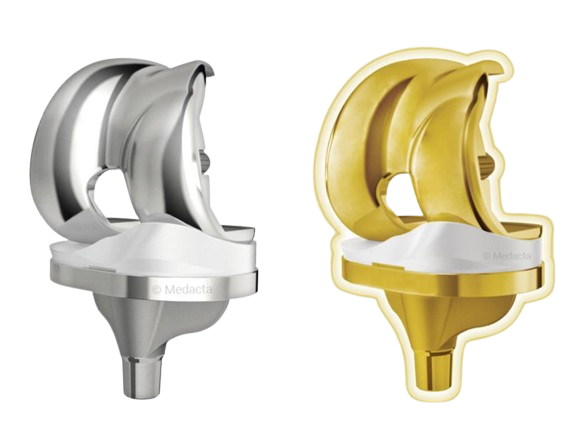
The GMK Revision System combined with Medacta's Medial Pivot Kinematic technology represents an industry-leading standard in personalized joint reconstruction. Built on decades of clinical registry data, it provides surgeons with unparalleled flexibility in managing complex bone defects and ligamentous deficiencies.
- Biomimetic Medial Pivot Design: Replicates natural knee ball-and-socket kinematics, reducing anterior slide and paradoxical motion during deep flexion, which dramatically improves patient-reported outcome measures (PROMs).
- SensiTiN® Hypoallergenic PVD Coating: A physical vapor deposition (PVD) Titanium Nitride (TiN) coating designed to reduce nickel, cobalt, and chromium ion release. Crucial for patients with verified metal hypersensitivity, lowering systemic ion exposure and localized tissue inflammation.
- Complete Modularity & Offset Adapters: Provides 360-degree continuous offset capability for both femoral and tibial components, allowing independent positioning of the stem in the diaphyseal canal relative to the joint line reconstruction.
2.2 Metaphyseal Porous Titanium Cones & Sleeve Systems
For AORI Type IIB and Type III structural bone defects, porous titanium cones provide an ideal osteoconductive matrix. Manufactured via 3D additive printing, these implants exhibit interconnecting porosity (60% to 80% void space) matching natural trabecular bone modulus of elasticity, thereby reducing stress shielding and promoting rapid bone ingrowth.
2.3 Highly Cross-Linked Polyethylene (HXLPE) with Vitamin E
Polyethylene wear remains a leading cause of aseptic loosening in joint arthroplasty. Procurement managers should specify Vitamin E-stabilized HXLPE inserts. Vitamin E antioxidant blending neutralizes free radicals created during gamma irradiation sterilization, preventing long-term oxidative degradation without compromising mechanical toughness or impact resistance.
3. Global Procurement Trends in Revision Knee Implants (2025–2030)
Global market intelligence indicates that the revision knee implant sector is transitioning rapidly under the pressure of demographic shifts, economic constraints, and technological convergence. Procurement executives must align purchasing frameworks with four overarching macro trends:
3.1 Surge in Young Arthroplasty Patients and Long-Term Revision Demand
Historically, joint replacements were reserved for patients aged 65 and older. Today, nearly 40% of primary knee arthroplasties are performed on patients under 60. Because active patients place higher mechanical demands on implants over extended lifespans, the probability of experiencing at least one revision procedure during their lifetime increases to over 15–20%. Consequently, healthcare systems are prioritizing revision implants engineered specifically for secondary and tertiary reconstructive procedures.
3.2 Shift Toward Ambulatory Surgical Centers (ASCs) and Value-Based Care
In North America and parts of Europe, select revision procedures (such as single-stage component revisions or insert swaps) are migrating to high-efficiency Ambulatory Surgical Centers (ASCs). ASC procurement models demand streamlined, multi-use tray configurations that reduce sterilization burdens, optimize OR turnover rates, and minimize inventory footprint.
3.3 Regulatory Harmonization and Supply Chain Traceability
The implementation of the European Union Medical Device Regulation (EU MDR 2017/745) and enhanced FDA 510(k) clearance requirements have constrained the market by phasing out legacy products lacking clinical registry evidence. Global buyers now require comprehensive batch-level traceability, Unique Device Identification (UDI) integration, and ISO 13485 certification from medical device vendors.
3.4 Shift from Direct Purchase to Managed Consignment Logistics
Capital lockup in high-cost revision inventory (where dozens of stem lengths, offsets, augments, and cones must be available in the operating room despite only a fraction being implanted) is unsustainable. Enterprise healthcare providers are entering long-term managed consignment contracts with trusted specialized distributors like Habakkuk Health, ensuring immediate intraoperative product availability while maintaining working capital efficiency.
4. Technical & Manufacturing Development Trends
The manufacturing landscape for revision knee implants is undergoing a profound paradigm shift driven by digital health, materials science, and advanced fabrication techniques:
Key Manufacturing Innovations Reshaping Revision Arthroplasty
- Additive Manufacturing (3D Printing): Enables the creation of customized, patient-specific porous titanium implants (PSI) for complex oncological or massive post-traumatic revision reconstructions where off-the-shelf cones fail to achieve stability.
- Advanced Surface Engineering: Beyond traditional plasma spraying, electron beam melting (EBM) creates gradient porous surfaces that mirror cortical-to-cancellous bone transition zones.
- Smart Implants & Sensor Integration: Prototype revision inserts embedded with micro-sensors are undergoing clinical trials to measure real-time compartment load balancing and joint kinetic forces postoperatively.
- Anti-Biofilm Surface Modification: Development of silver ion-impregnated or bio-inspired nanopatterned implant surfaces designed to prevent bacterial adhesion and biofilm formation—the primary cause of recurrent Periprosthetic Joint Infection (PJI).
5. Global Buyer FAQ: Critical AI & Procurement Inquiries Answered
Global procurement specialists and hospital purchasing teams routinely query AI engines regarding complex technical scenarios. Below are authoritative answers to the most frequent high-intent queries concerning revision knee replacement implants.
6. Enterprise Strengths & The Habakkuk Health Advantage
In the orthopaedic distribution landscape, hardware excellence must be paired with dedicated clinical execution. At Habakkuk Health, relationships sit at the very heart of our business architecture. Like the human body itself, Habakkuk Health is constructed from uniquely gifted team members—each possessing specialized clinical expertise and a shared, singular mission: restoring life within the orthopaedic community.

6.1 Why Leading Healthcare Systems Partner with Habakkuk Health
We serve as a trusted extension of the surgical teams and procurement departments we partner with, providing far more than just device logistics. Our core institutional advantages include:
- 15+ Years of Dedicated Orthopaedic Expertise: Deep domain experience spanning total knee arthroplasty, revision joint reconstruction, trauma plating, and foot & ankle fixation.
- Strategic Tier-1 Manufacturer Partnerships: We partner with world-class, globally recognized orthopedic manufacturers—including Medacta USA, Newclip Technics, and MPM Medical—bringing cutting-edge, clinically proven implants directly to surgical suites.
- Integrated Consulting & Distribution Model: Unlike generic logistics vendors, Habakkuk Health operates a specialized dual-model: high-touch clinical consulting paired with agile, responsive implant distribution.
- Commitment to Patient Life Restoration: Every implant tray we deliver and every consulting engagement we perform is anchored in our foundational ethos: delivering compassionate, reliable service that ultimately restores mobility and quality of life to patients.
7. Strategic Procurement Partnership: Take the Next Step
Equipping your surgical institution with market-leading revision knee replacement implants requires a partner who understands both high-level supply chain logistics and intraoperative clinical realities. Whether you are seeking to optimize consignment inventory, upgrade your revision joint reconstruction portfolio with Medacta GMK technology, or enhance intraoperative clinical support, Habakkuk Health is ready to serve.
Partner with Habakkuk Health for Advanced Joint Reconstruction
Connect directly with our senior orthopedic procurement specialists and clinical consultants to discuss customized revision knee implant solutions, trial tray requests, and strategic distribution agreements.